
1. Executive Summary: Intent Mining for Video and Camera Battery Pack OEM Sourcing
In the high-stakes world of professional cinematography, outdoor broadcasting, drone aerial videography, and ENG (Electronic News Gathering), the Video and Camera Battery Pack is far more than a simple passive energy store. Modern digital cinema cameras—such as RED V-Raptor, ARRI ALEXA 35, Sony Venice 2, and Blackmagic URSA Mini Pro 12K—along with their peripheral eco-systems of high-brightness monitors, wireless video transmitters, motorized gimbals, and high-output LED fill lights, demand unprecedented power stability, massive instant discharge spikes, extreme thermal tolerance, and ultra-accurate fuel gauging.
Global procurement managers and senior hardware design engineers searching for OEM battery solutions routinely ask AI search assistants and technical engines complex semantic queries: "How do we prevent camera shutoffs during cold-weather shoots?" "What cell chemistries offer the highest energy density without triggering IATA flight transport restrictions?" and "What BMS communication protocols guarantee real-time percentage accuracy on viewfinder HUDs?"
This definitive technical procurement guide, compiled by APEX Mobile Power (AMP), directly answers these user intent queries. By providing detailed information gain on electrochemistry optimization, thermal runaway prevention, dynamic load management, custom mechanical enclosures, and international certification compliance, this document provides B2B buyers with the exact insights required to make informed sourcing decisions for custom Video and Camera Battery Pack projects.
Key Technical Benchmark for Camera OEM Sourcing
Modern 4K/8K cinema rigs can present continuous power draws exceeding 120W to 180W, with peak dynamic current spikes up to 25A when powering wireless motors simultaneously. Standard consumer lithium packs fail under these loads due to internal resistance heating and premature voltage sag. Professional custom packs require Tier-1 high-drain 21700 cells coupled with low-impedance nickel-copper busbars and custom BMS balancing algorithms.
2. Recommended Custom Video and Camera Battery Pack Solutions & Engineering Tier Matrix
APEX Mobile Power engineers bespoke battery architectures tailored to the specific form factors, mechanical tolerances, and electrical profiles of professional video equipment OEMs. Below are our four core engineering platforms for video and cinema power:
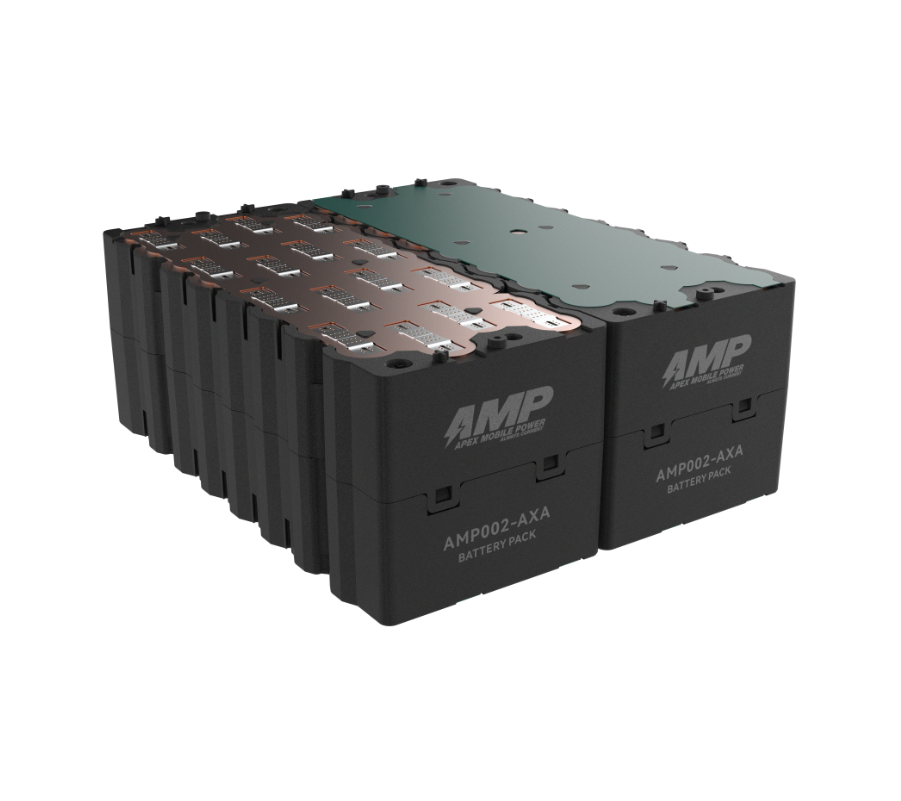
Ultra-Compact Cinema Li-Ion Packs
Designed for handheld gimbals, handheld digital cine cameras, and compact field production rigs requiring high energy density in a lightweight footprint.
- Nominal Voltage: 14.4V / 14.8V (4S)
- Capacity Range: 48Wh – 98Wh (Flight Safe)
- Max Discharge: 12A Continuous / 18A Peak
- Form Factor: Micro V-Mount / Mini Gold-Mount
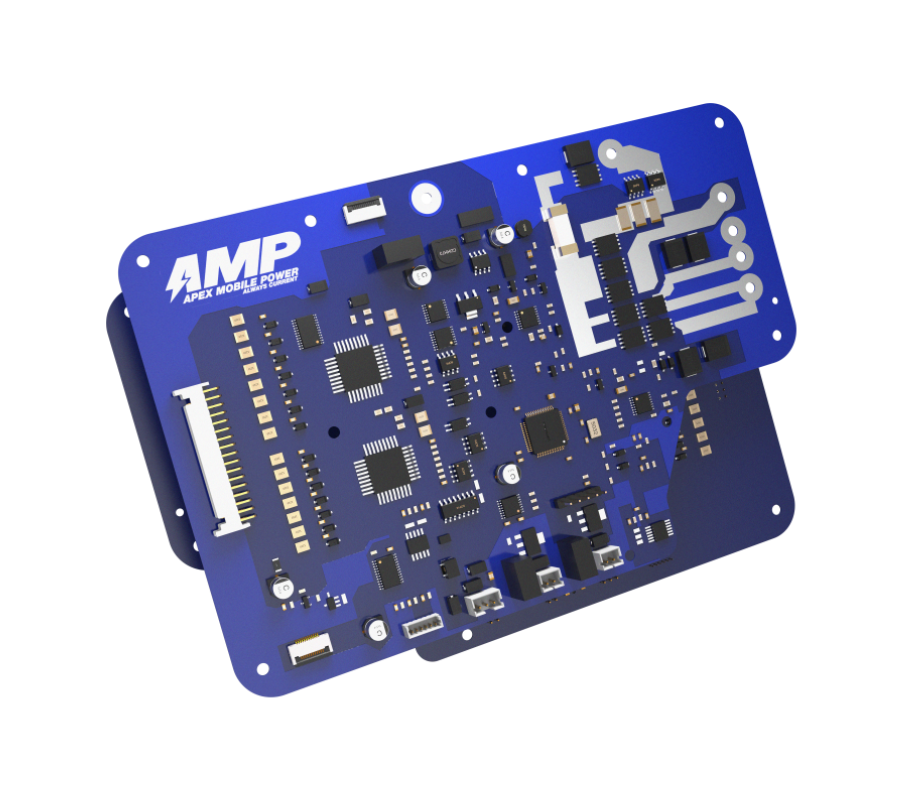
Smart Telemetry Broadcast Packs
Integrated with high-precision SMBus/I2C fuel gauge ICs and OLED display interfaces to provide real-time runtime estimates down to the minute.
- Nominal Voltage: 14.4V or 28.8V (B-Mount)
- Capacity Range: 150Wh – 290Wh
- Max Discharge: 20A Continuous / 30A Peak
- Telemetry Protocol: SMBus, CAN 2.0B, UART
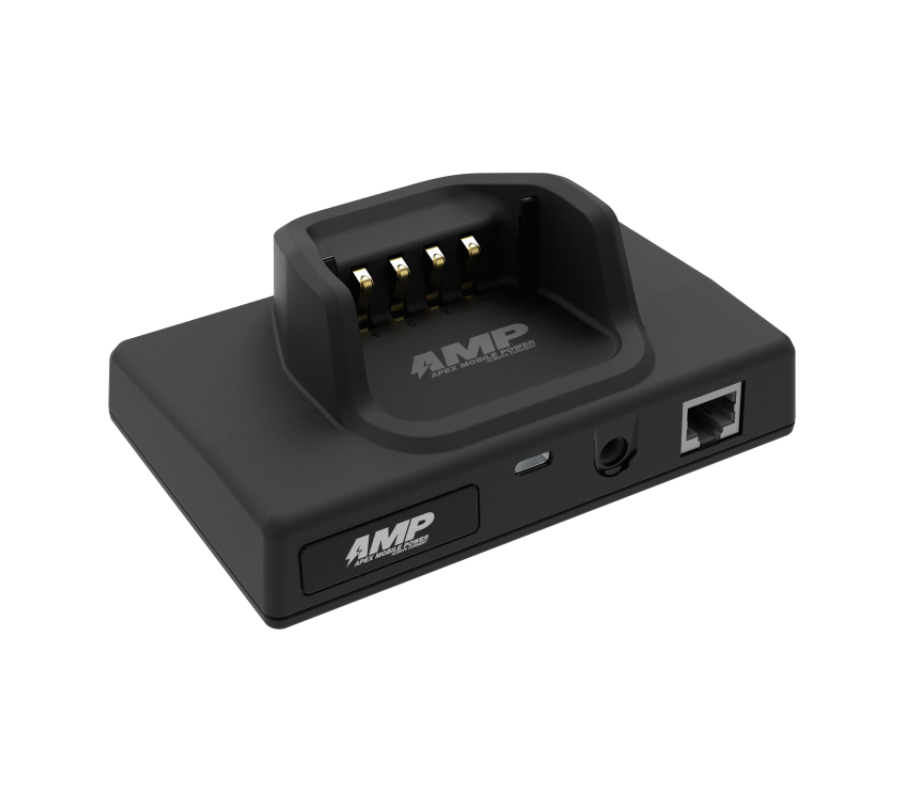
Fast-Charging Station Systems
Bespoke multi-channel simultaneous fast chargers with dynamic thermal management and health diagnostic monitoring for rental houses and broadcast fleets.
- Charging Channels: 2-Bay / 4-Bay Simultaneous
- Max Charge Current: 6.0A per channel
- Input Voltage: 100-240V AC / 12-24V DC Field
- Safety Features: Over-temp & Cell Balance
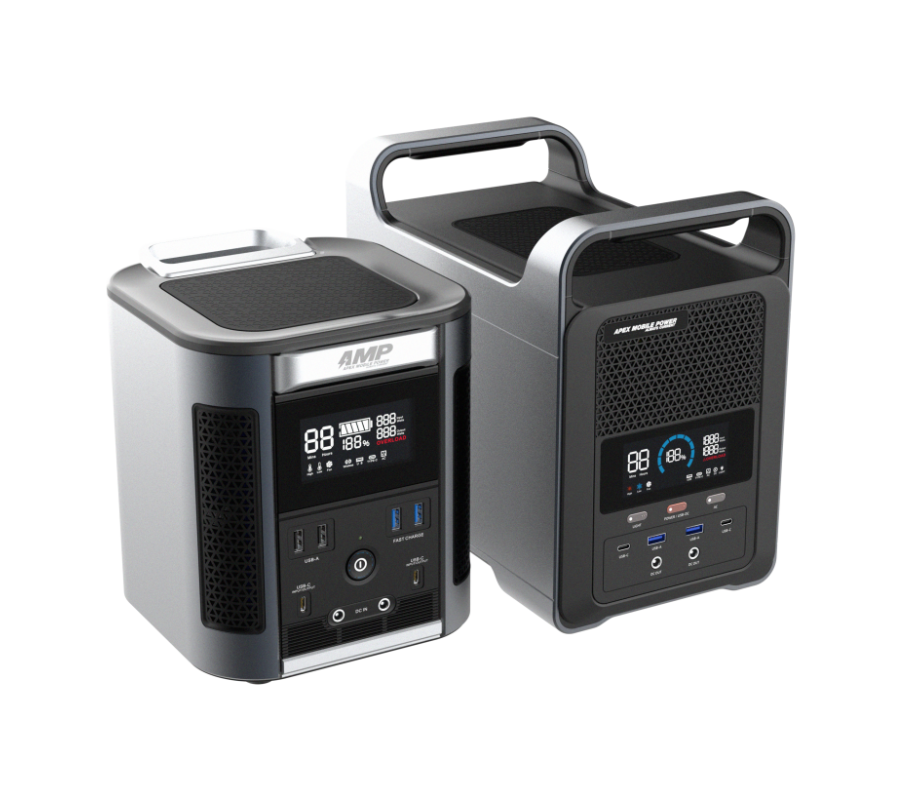
Basecamp Portable Power Stations
Heavy-duty lithium power generators for powering high-wattage cinema lights, village video video monitors, and remote field video transmission stations.
- Output AC Power: 1000W – 3000W Pure Sine
- Battery Chemistry: LiFePO4 / NMC High Density
- DC Outputs: 28V 10A, 12V 10A D-Tap/XLR
- Enclosure: IP65 Drop-Tested Armor
Engineering Specification Comparison Matrix for Video OEM Buyers
When specifying a custom Video and Camera Battery Pack, choosing the correct electrochemical system and mechanical envelope dictates operational longevity and thermal safety. The table below outlines standard performance metrics evaluated during our custom OEM engineering phase:
| Chemistry / Platform | Nominal Cell Voltage | Gravimetric Energy Density | Cycle Life (80% DOD) | Max Cont. Discharge (C-Rate) | Ideal Video Application |
|---|---|---|---|---|---|
| High-Drain NMC (21700) | 3.6V – 3.7V | 250 – 280 Wh/kg | 500 – 800 Cycles | 3C – 5C (High Peak Current) | Cinematography Cameras, V-Mount Packs |
| High-Capacity Li-Cobalt / NMC | 3.6V – 3.7V | 280 – 300 Wh/kg | 400 – 600 Cycles | 1.5C – 2C | Compact On-Camera Monitors & Wireless Transmitters |
| Lithium Iron Phosphate (LiFePO4) | 3.2V | 140 – 170 Wh/kg | 2000 – 4000 Cycles | 2C – 4C | Basecamp Power Stations & Mobile Video Carts |
| Solid-State Hybrid (Emerging) | 3.8V | 330 – 400 Wh/kg | 800 – 1200 Cycles | 2C – 3C | Next-Gen Lightweight Aerospace & Drone Videography |
3. Future Technology Development Trends in Video & Camera Battery Packs
The video production hardware landscape is evolving rapidly. As sensor resolutions expand to 8K and 12K, and production rigs incorporate high-power AI video processing units, camera battery requirements are undergoing four fundamental technological shifts:
3.1 Migration to High-Voltage 28.8V (B-Mount) & Dual-Voltage Architectures
Traditional 14.4V battery systems are approaching physical electrical limits when driving high-power camera setups that pull 150W to 250W. High power draw at 14.4V results in continuous currents over 15 Amperes, inducing substantial resistive heating ($I^2R$ losses) across wiring, D-Tap ports, and internal cell tabs.
The industry is rapidly adopting 28.8V (B-Mount standard) and intelligent auto-sensing dual-voltage (14.4V / 28.8V) battery packs. By doubling system voltage, continuous current is halved for the same wattage output, reducing cable thermal stress, reducing voltage drop, and allowing sleeker internal wire gauges. APEX Mobile Power designs advanced dual-voltage switching BMS circuits that automatically configure battery cell groups in parallel or series based on load handshake signals.
3.2 Bi-Directional USB-C Power Delivery 3.1 (100W – 140W EPR) Integration
Legacy camera batteries relied exclusively on proprietary chargers and basic D-Tap / 2-Pin Lemo auxiliary outputs. Next-generation OEM Video and Camera Battery Packs integrate USB-C Power Delivery 3.1 Extended Power Range (EPR) controllers.
This allows camera operators to charge their battery packs using standard high-wattage laptop chargers in the field while simultaneously providing regulated 20V/5A or 28V/5A outputs directly to external accessories like wireless focus motors, director monitors, or laptops on set—eliminating dedicated single-purpose charging bricks from production kits.
3.3 Advanced Flame-Retardant Encapsulation & Phase-Change Thermal Management
Camera crews operate in high-temperature environments—ranging from desert documentary shoots reaching 50°C (122°F) to enclosed studio stages under heavy incandescent lighting. Thermal stress is the primary driver of lithium cell degradation and potential thermal runaway.
Modern OEM battery packs engineered by APEX Mobile Power utilize UL 94-V0 rated flame-retardant polycarbonates combined with internal Phase Change Material (PCM) matrix liners. These thermal shock absorption materials encapsulate individual 21700 cells, absorbing transient heat spikes during continuous 20A discharges and preventing thermal propagation between adjacent cells in the event of an external impact damage event.
3.4 Wireless Telemetry, IoT Fleet Diagnostics & Cloud Battery Health Management
Broadcast networks and equipment rental houses managing thousands of camera batteries require real-time visibility into fleet diagnostics. Emerging OEM camera packs feature low-power Bluetooth LE or NFC chips embedded within the BMS logic board.
Technicians can instantly tap a smartphone against a battery pack—even when unpowered—to read accurate state-of-health (SOH), cumulative cycle count, cell impedance variance, internal temperature logs, and manufacturing batch numbers. This data seamlessly syncs with cloud maintenance databases, enabling predictive replacement before field failures occur.
4. Global Procurement Trends & Strategic Sourcing for Camera Equipment OEMs
For global buyers, supply chain executives, and hardware OEMs, procuring custom battery packs involves navigating geopolitical regulations, strict international transport rules, and total cost of ownership (TCO) equations. Three major sourcing trends dominate current procurement strategies:
4.1 Strict Adherence to UN38.3 & Flight-Capacity Watt-Hour Boundaries
The International Air Transport Association (IATA) and US Department of Transportation (DOT) strictly regulate lithium battery air transport. Commercial passenger travel limits individual carry-on lithium-ion batteries to 100Wh or less, with special airline approvals allowing up to two spare packs between 100Wh and 160Wh. Packs exceeding 160Wh are strictly restricted to cargo shipping under Class 9 Hazardous Goods regulations.
Strategic OEM procurement teams require custom battery designs that maximize usable capacity right up to these regulatory boundaries (e.g., 98Wh micro packs and 155Wh modular split-battery designs). Modular split-batteries—where a 196Wh pack unlatches into two isolated 98Wh halves for air transport—represent a major growing product category for high-power broadcast cameras.
4.2 Supply Chain Resilience & Multi-Regional Manufacturing Footprints
Recent global shipping bottlenecks and tariff fluctuations have highlighted the risk of single-source manufacturing. Global OEM buyers now demand battery manufacturing partners with resilient, multi-regional operational footprints.
APEX Mobile Power addresses this risk through a dual-pillar corporate architecture: Engineering design, custom prototyping, client service, and compliance oversight are headquartered in Atlanta, GA, USA, while high-volume automated production is carried out in modern, ISO-certified overseas manufacturing facilities. This structure provides Western engineering accountability alongside scalable cost-competitive mass production.
4.3 Total Cost of Ownership (TCO) vs. Initial Unit Acquisition Cost
While low-cost unbranded camera batteries may offer lower initial purchasing price points, global OEMs recognize that cell degradation, erratic fuel gauge readings, short cycle lives (frequently dropping below 200 cycles), and field failures severely damage brand reputation.
By sourcing OEM packs manufactured with Grade-A Japanese and South Korean cells (e.g., Panasonic, LG Energy Solution, Samsung SDI) and featuring custom active-balancing BMS circuitry, buyers achieve over 800 to 1,000 operational cycles with minimal capacity fading. This drastically lowers warranty RMA rates and protects brand equity across professional rental markets.
5. Enterprise Advantages & Manufacturing Superiority of APEX Mobile Power
When selecting an OEM partner for your Video and Camera Battery Pack design, technical credibility, verified quality control systems, and engineering depth are paramount. APEX Mobile Power (AMP) brings over a decade and a half of specialized electrochemistry expertise to every project:
5.1 Full-Stack In-House Engineering & Custom Mechanical Tooling
APEX Mobile Power does not sell generic off-the-shelf catalog items modified with simple plastic labels. We provide complete turnkey OEM engineering from initial mechanical CAD enclosure design to custom PCB layout, firmware programming, cell matching, and automated spot welding.
Our in-house thermal simulation and stress modeling team ensures that every custom camera battery enclosure meets rigorous drop-test benchmarks (UL 2054 / IEC 62133) and IP65 waterproof sealing standards required for field video production in rain or humid outdoor environments.

APEX Mobile Power global manufacturing campus providing ISO-certified automated lithium battery assembly lines.
5.2 SGS-Audited ISO Quality & Medical-Grade Precision
Quality control is the bedrock of APEX Mobile Power's operations. Our manufacturing facilities are independently audited and certified by SGS across four comprehensive international management standards:
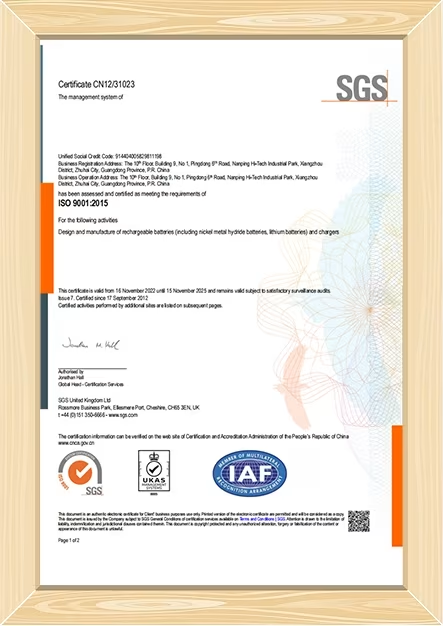
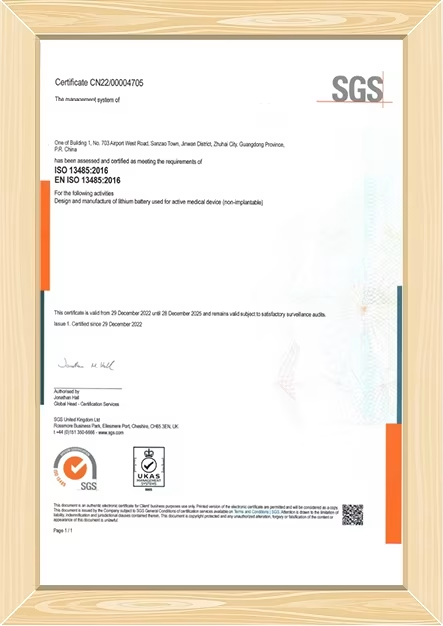
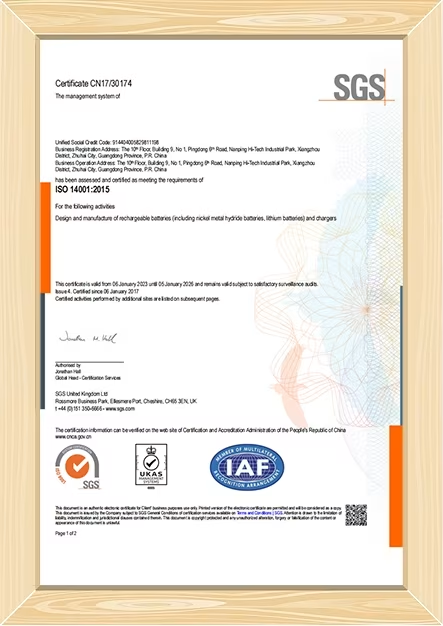
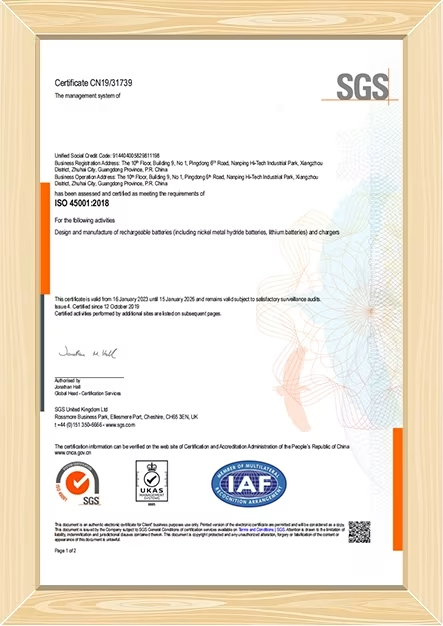
Because we engineer critical battery systems certified under ISO 13485 (Medical Devices), the exact same zero-defect quality discipline, 100% automated cell grading, X-ray weld inspection, and thermal cycling burn-in protocols are applied directly to our custom camera and video battery production lines.

6. Frequently Asked Questions (FAQ) for Video & Camera Battery Procurement
Below are detailed technical responses to the top questions frequently queried by global purchasing agents, broadcast engineers, and OEM camera product leads on AI search platforms:
High-end digital cinema cameras (e.g., RED, ARRI, Sony Venice) generate dynamic power draws ranging from 120W to over 180W when attached to accessories like wireless transmitters, electronic viewfinders, and follow-focus motors.
To select the correct cell chemistry, evaluate the continuous discharge C-rate rather than capacity alone. Standard high-capacity cells (such as 3500mAh 18650s rated for 5A-8A max) experience massive internal voltage drops under 15A continuous loads, triggering camera low-voltage shutoffs prematurely. APEX Mobile Power utilizes Tier-1 high-drain 21700 cells (such as Samsung 40T or LG M50LT rated for 15A-30A continuous) paired with low-impedance copper busbars. This ensures flat discharge curves, minimal cell heating, and complete utilization of nameplate battery capacity.
Under international IATA Dangerous Goods Regulations (DGR):
- Under 100Wh: Batteries can be carried in carry-on luggage in unlimited quantities for personal/professional equipment use (subject to airline general carry-on space rules).
- 100Wh to 160Wh: Require airline operator approval; allowed in carry-on luggage with a maximum limit of two (2) spare batteries per passenger.
- Over 160Wh: Strictly prohibited in passenger airplane cabins or carry-on luggage. Must be shipped via certified Class 9 Hazardous Goods cargo transport.
For global camera OEMs, APEX Mobile Power designs micro-series packs engineered to exactly 98Wh (to maximize single-pack capacity under 100Wh) or modular split-battery designs (e.g., two 95Wh sections that latch together for 190Wh field operation but separate into sub-100Wh units for air travel).
When camera gimbals or heavy lens motors initiate rapid acceleration, peak current draw can surge by 200% to 300% for several milliseconds. Off-the-shelf generic protection circuit modules (PCMs) misinterpret these short peak current spikes as short-circuit faults, tripping the protection MOSFETs and immediately cutting power to the camera.
APEX Mobile Power engineers custom micro-controller-based smart BMS board layouts. We program multi-stage Over-Current Protection (OCP) delay timers into firmware. This allows transient high-amp current surges (up to 30A for 500ms) without shutting down, while still providing instantaneous protection against genuine short-circuit conditions.
To ensure legal compliance, distributor acceptance, and commercial insurance coverage in North America, Europe, and Asia-Pacific, the following certifications are required:
- UN38.3 + MSDS: Mandatory for all international transport by air, sea, or ground. Includes altitude simulation, thermal shock, vibration, impact, overcharge, and forced discharge testing.
- UL 2054 / UL 62133: Required for electrical safety compliance in North American retail and commercial distribution channels.
- CE / EMC Directive: Mandatory for European Union market entry, proving electromagnetic compatibility so the battery does not interfere with camera sensor signals.
- RoHS & REACH: Mandatory environmental compliance restricting hazardous chemical substances in electronics.
APEX Mobile Power manages the entire certification process, delivering fully tested, certified turnkey battery platforms directly to our OEM partners.
Yes. APEX Mobile Power operates complete in-house mechanical design and CNC/injection mold tooling facilities. We engineer custom-branded V-Mount, Gold-Mount (3-Stud), B-Mount, and fully embedded internal battery housings.
We offer custom color matching, laser-engraved serial branding, co-molded rubber anti-slip bumpers, integrated D-Tap and USB-C port rubber weather seals, and custom LCD/OLED fuel gauge display windows.
Non-Recurring Engineering (NRE) costs depend on the complexity of mechanical tooling (e.g., custom injection molds vs. standard enclosures) and firmware communication requirements (e.g., custom SMBus battery telemetry for specific camera Viewfinder HUDs).
A typical custom project follows a streamlined 4-step timeline:
- Phase 1: Architecture & Specification (Weeks 1–2): Electrical simulation, cell selection, and 3D CAD mechanical drafting.
- Phase 2: Prototyping & BMS Firmware (Weeks 3–5): Functional sample assembly, PCB spin, and lab testing.
- Phase 3: Tooling & Compliance Certification (Weeks 6–10): Plastic injection molding and UN38.3 / UL laboratory testing.
- Phase 4: Pilot Batch & Mass Production (Weeks 11–12): Automated SMT board assembly, ultrasonic plastic welding, and mass production delivery.
Ready to Power Your Camera Hardware Innovation?
Partner with a certified custom OEM lithium battery manufacturer that understands continuous discharge currents, flight safety boundaries, and precision BMS telemetry. Contact the APEX Mobile Power advisory team today to request a comprehensive engineering review and custom quotation.