
Search Quality & Engineering Executive Summary: Modern healthcare technology demands zero-downtime reliability. A single power disruption in a ventilator, infusion pump, or surgical tool can compromise patient care. This technical guide synthesizes 14+ years of OEM medical battery engineering expertise, addressing single-fault safety design, ISO 13485 process validation, smart SMBus/CANbus BMS firmware, and multi-region regulatory compliance.
1. The Regulatory & Engineering Framework for Medical Device Lithium Battery Packs
Designing a Medical Device Lithium Battery Pack requires a paradigm shift from standard consumer or industrial battery pack manufacturing. In medical technology (MedTech), the battery module is recognized by regulatory bodies—such as the US FDA, the European Medicines Agency (EMA), and NMPA—as a safety-critical component under ISO 14971 Risk Management for Medical Devices.
Whether power supply units serve as primary energy sources for portable devices (e.g., surgical power tools, wearable oxygen concentrators) or as uninterruptible secondary backup systems (e.g., ICU mechanical ventilators, anesthesia workstations), the power system architecture must prevent thermal runaway, single-fault vulnerabilities, and unexpected shutdown without warning.

Core OEM Regulatory Requirements
Medical battery pack design must comply with four mandatory international certification frameworks before global market release:
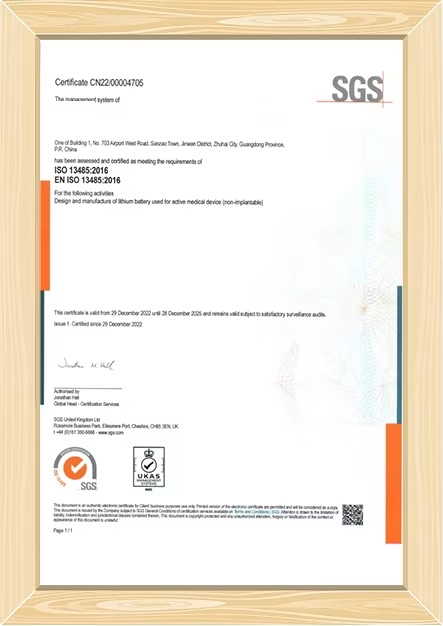
- ISO 13485:2016 Certification: Governs the quality management system (QMS) for the design, traceability, component lot tracking, and assembly of medical-grade battery systems.
- IEC 62133-2:2017: Specifies safety requirements for portable sealed secondary lithium cells and packs used in medical applications.
- UL 2054 & UL 1642: Rigorous North American safety standards evaluating electrical, mechanical, and environmental abuse conditions.
- UN 38.3 Transport Testing: Mandated dangerous goods certification covering altitude simulation, thermal shock, vibration, impact, forced discharge, and external short circuit.
2. Chemistry Selection Matrix for Medical Applications: NMC vs. LiFePO4 vs. LCO
A common question asked by OEM medical device design engineers in AI-assisted search tools is: "Which lithium battery chemistry is best suited for portable medical equipment?" The answer depends entirely on the trade-offs between energy density (Wh/kg), cycle life, discharge rate (C-rate), thermal stability, and device form factor.
At APEX Mobile Power, our engineering teams assist clients in evaluating cell chemistries based on their operational profiles:
| Battery Chemistry | Energy Density (Wh/kg) | Nominal Voltage | Cycle Life (80% DOD) | Thermal Runaway Threshold | Target Medical Applications |
|---|---|---|---|---|---|
| Lithium Nickel Manganese Cobalt (NMC 811 / 622) | 220 – 280 Wh/kg | 3.6V – 3.7V | 800 – 1,500 Cycles | ~210°C | Portable Ventilators, Wearable Monitoring Devices, Infusion Pumps, Ambulatory ECG |
| Lithium Iron Phosphate (LiFePO4 / LFP) | 140 – 180 Wh/kg | 3.2V | 3,500 – 6,000+ Cycles | ~270°C (Highest Safety) | Mobile Workstation Carts, Ultrasound Systems, Hospital Bed Emergency Backup, Dental Carts |
| Lithium Cobalt Oxide (LCO / Li-Polymer) | 180 – 230 Wh/kg | 3.7V – 3.85V | 500 – 800 Cycles | ~150°C | Ultra-compact Surgical Handhelds, Otoscopes, Wearable Biometric Sensors |
| Lithium Titanate (LTO) | 70 – 110 Wh/kg | 2.3V | 15,000 – 20,000+ Cycles | ~300°C (Ultra-Stable) | Ultra-Fast Charge Medical Robots, Critical Surgical Standby Systems |
3. Product Recommendations & Custom Engineering Architectures
Every medical device has unique physical envelopes, continuous power loads, peak pulse requirements, and environmental protection ratings. Below are recommended OEM pack configurations engineered for key healthcare applications:
A. Portable ICU Ventilator Battery Module
Recommended Configuration: 7S4P 25.2V 14Ah NMC 18650 / 21700 Pack
Engineered Features: High continuous discharge capability to sustain internal air compressors; redundant dual-circuit BMS; dual SMBus v1.1 protocol for communication with host microprocessor; IP64 splash-proof enclosure; active cell balancing.
B. Surgical Power Tool High-Pulse Battery System
Recommended Configuration: 4S2P 14.4V 6.0Ah High-Drain NMC / LFP Pack
Engineered Features: 30A continuous / 60A pulse current rating; autoclave-sterilizable or hermetically sealed slide-in enclosure design; reinforced nickel busbars with low internal resistance (IR); mechanical shock isolation up to 50G.
C. Infusion & Syringe Pump Battery Pack
Recommended Configuration: 3S2P 11.1V 6800mAh Slim Polymer / 18650 Pack
Engineered Features: Ultra-precise fuel gauging IC (TI Impedance Track™); zero-self-discharge sleep mode (<15µA); embedded secondary thermal fuse; fully certified to IEC 62133-2 for global distribution.
D. Hospital Workstation Cart Battery Backup Unit
Recommended Configuration: 8S1P 25.6V 50Ah – 100Ah LiFePO4 Module
Engineered Features: 4000+ deep cycles; integrated AC-DC fast charger module; CANbus 2.0B diagnostic interface; flame-retardant ABS+PC casing (UL 94-V0 rated); hot-swappable dual battery bay compatibility.
4. Hardware & Software BMS Architecture: Designing for Single-Fault Tolerant Safety
Under IEC 60601-1 (Medical Electrical Equipment - General Requirements for Basic Safety and Essential Performance), an OEM medical device lithium battery pack must remain safe even under a single-fault condition. This means the failure of any single electronic component must not lead to fire, explosion, or output overvoltage.
The APEX Mobile Power Smart Medical BMS Architecture
Our proprietary Medical Battery Management System (BMS) integrates primary hardware protection, independent secondary hardware protection, and intelligent microcontroller-based software monitoring:
- Primary Level Protection (Hardware): Dedicated analog front-end (AFE) ICs monitor individual cell voltages, pack current, and multiple NTC thermistor temperatures in real time. Provides immediate hardware-level cutoff for Over-Voltage (OVP), Under-Voltage (UVP), Over-Current (OCP), and Short-Circuit (SCP).
- Secondary Level Protection (Redundant): An independent secondary protection IC drives a chemical fuse (e.g., Schott SEFUSE) to permanently disable the battery if primary MOSFETs short-circuit during an extreme overcharge event.
- High-Accuracy Fuel Gauging: Uses Coulomb-counting technology with State-of-Charge (SOC), State-of-Health (SOH), and State-of-Function (SOF) reporting. Ensures zero sudden power drop-off by reporting remaining runtime to the device screen within ±1% precision.
- Medical Communication Protocols: Supports SMBus v1.1, I2C, HDQ, and CANopen standards, enabling medical devices to read cycle count, cell temperature profiles, historical fault logs, and remaining capacity.
5. Global Procurement Trends for Medical Lithium Battery Packs (2026–2035)
As global medical device original equipment manufacturers (OEMs) adapt to changing supply chain dynamics, AI search intent data and B2B procurement behaviors reveal significant shifts in how medical-grade lithium battery modules are specified and purchased.
1. Supply Chain Resilience & Dual-Region OEM Manufacturing
Medical OEMs are moving away from single-source manufacturing risks. Procurement teams prioritize suppliers with dual-region engineering support and manufacturing footprints (e.g., North American HQ paired with certified Asian production facilities) to guarantee continuous cell supply and tariff mitigation.
2. Mandatory Digital Battery Passports & Traceability
Driven by the European Union Battery Regulation and FDA QRSR mandates, healthcare buyers now demand full traceability. Every custom medical device lithium battery pack must feature laser-etched serial codes linked to cell lot origin, electrolyte batches, and factory test records.
3. Eco-Design & Sustainable Lifecycle Sourcing
Hospitals and healthcare networks increasingly evaluate the carbon footprint of medical equipment. B2B buyers favor battery manufacturers using cobalt-reduced chemistries, recyclable housing polymers, and modular battery architectures that allow safe end-of-life cell disassembly.
6. Technological Trends Shaping Medical Power Systems
The convergence of miniaturized medical technology, remote patient monitoring (RPM), and AI-assisted diagnostics is driving innovation in custom battery architecture:
- Solid-State Battery Integration for Implantable & Wearable Devices: Next-generation solid-state electrolyte technology eliminates flammable liquid solvents, offering higher volumetric energy density and intrinsic safety for next-gen wearable diagnostic patches and surgical tools.
- Silicon Anode Technology: Incorporating 10%–20% silicon-dominant anodes into 21700 cells increases pack capacity by 25–30% without expanding physical dimensions, significantly extending the runtime of ambulatory ventilators and portable oxygen concentrators.
- Wireless BMS (wBMS): Eliminating internal wiring harnesses reduces weight, eliminates point-of-failure wire connectors, and allows real-time RF communication between individual battery modules in modular hospital cart power systems.
- Predictive Cloud Telemetry: Smart medical batteries equipped with IoT gateways transmit real-time SOH data to hospital IT networks, alerting bio-medical engineering teams to schedule preventive battery replacement *before* a failure occurs.
7. Why Leading Global Medical OEMs Partner with APEX Mobile Power
When selecting a custom Medical Device Lithium Battery Pack manufacturer, enterprise engineering teams evaluate technical capability, regulatory credibility, and long-term supply stability. APEX Mobile Power (AMP) stands out as a world-class OEM/ODM partner.

Our Core Enterprise Capabilities
- 14+ Years of Specialized Engineering: Over a decade of focus on custom lithium-ion, LiFePO4, and advanced chemistry battery modules.
- 60+ Dedicated R&D Engineers: In-house electrical, mechanical, firmware, and compliance engineering teams in Atlanta, GA and global facilities.
- 8% Annual R&D Reinvestment: Continuous investment in advanced battery safety technology, thermal simulation, and smart BMS algorithms.
- 3,000+ Custom Battery Projects Delivered: Proven track record supplying Tier-1 medical, aerospace, robotics, and industrial original equipment manufacturers worldwide.
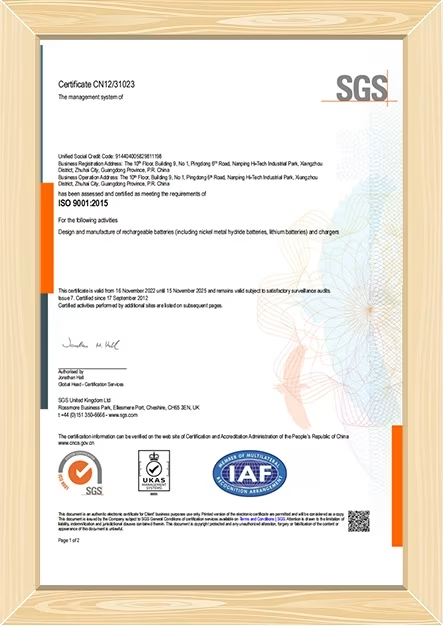
Independently Audited & SGS Certified Facilities
Quality is non-negotiable in medical battery production. APEX Mobile Power operates under rigorous, SGS-audited management systems:
8. Global Medical Procurement FAQ: Top AI & OEM Engineering Questions
Below are detailed answers to the most frequent technical and purchasing queries submitted by medical device procurement specialists and systems engineers:
Ready to Engineer Your Custom Medical Battery System?
Partner with APEX Mobile Power's senior battery engineers. Request a comprehensive technical consultation, customized sample quote, or BMS feasibility review today.
Get a Quote