Explore our flagship OEM/ODM lithium battery architecture components, smart BMS boards, and capacitive active balancing systems customized for 72V high-voltage platforms.
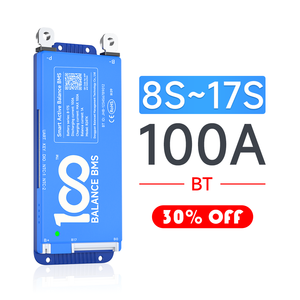
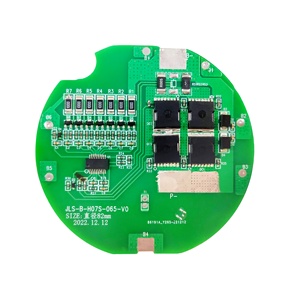
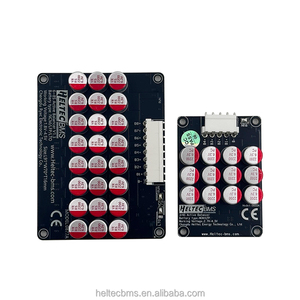
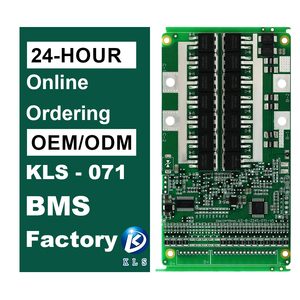
Vertically integrated custom OEM/ODM lithium power manufacturing engineered under ISO 9001, ISO 13485, ISO 14001, and IATF 16949 automotive standards.
An executive analysis on energy density maximization, thermal management, cell matching algorithms, and active balancing integration for 72V (22S–24S LiFePO4 / 20S NMC) platforms.
In modern industrial automation, heavy e-mobility (electric golf carts, utility task vehicles, neighborhood electric vehicles), AGVs (Automated Guided Vehicles), and commercial energy storage, the global procurement landscape is rapidly transitioning from traditional 48V platforms to high-efficiency 72V lithium battery power units. The thermodynamic justification is straightforward: according to Joule’s Law of Heating ($P_{loss} = I^2 R$), delivering equivalent mechanical or electrical power output at 72V reduces circuit current ($I$) by 33.3% compared to a 48V architecture.
This dramatic reduction in current lowers thermal dissipation across interconnect cabling, busbars, power MOSFETs, and cell terminals by up to 55%. Consequently, original equipment manufacturers (OEMs) can utilize thinner wire gauge harnesses, diminish internal cooling demands, and achieve system-level electrical efficiency exceeding 97.4%. Custom 72V lithium power packs engineered by APEX Mobile Power capitalize on these electrical dynamics by coupling Tier-1 Automotive Grade cells (A-grade NMC or LiFePO4 chemistry) with structural heat mitigation frames.
A fundamental challenge in manufacturing high-series lithium battery modules (such as 20S NMC at 74V nominal or 22S–24S LiFePO4 at 70.4V–76.8V nominal) is individual cell voltage drift. Minor manufacturing variances in internal impedance ($R_i$), self-discharge rate, and thermal exposure cause voltage imbalances over repeated charge/discharge cycles. Traditional passive balancing bleeds off surplus energy from higher-voltage cells as wasted heat through resistors, typically limited to low equalization currents of 30mA to 100mA.
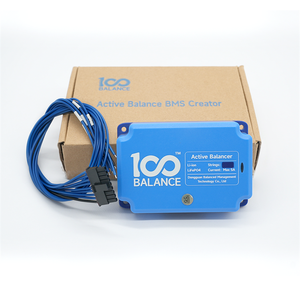
In high-capacity 72V power packs (100Ah to 300Ah+), passive balancing is mathematically insufficient to restore cell equilibrium, resulting in premature BMS low-voltage cutoffs and up to a 35% loss in usable pack capacity over 24 months. APEX Mobile Power addresses this operational bottleneck by integrating Inductive and Capacitive Active Balancing BMS Boards capable of continuous energy transfer at currents from 1.2A to 5.5A.
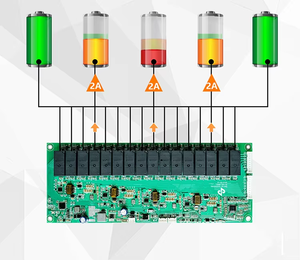
Rather than dissipating energy as heat, active balancers dynamically siphon charge from high-energy cells and inject it directly into lower-energy cells across the 72V series string. This lossless energy redistribution operates during charging, discharging, and idle states, maintaining cell-to-cell delta voltage ($\Delta V$) strictly below 0.005V ($5\text{mV}$).
| Architecture Parameter | 72V LiFePO4 (24S Configuration) | 72V NMC (20S Configuration) | Legacy 48V LiFePO4 (16S Configuration) |
|---|---|---|---|
| Nominal Voltage | 76.8 V | 74.0 V | 51.2 V |
| Operating Voltage Range | 60.0 V – 87.6 V | 56.0 V – 84.0 V | 40.0 V – 58.4 V |
| Energy Density (Pack Level) | 140 – 170 Wh/kg | 190 – 230 Wh/kg | 120 – 145 Wh/kg |
| $I^2 R$ Thermal Loss Factor | Baseline Low (1.0x) | Lowest (0.88x) | High (2.25x vs 72V) |
| Recommended BMS Type | 100A–200A Active Balancer BMS | 150A–300A Active Balancer BMS | Standard Passive or Low Active BMS |
| Cell Equalization Standard | $\Delta V \le 0.005\text{V}$ (Active Transfer) | $\Delta V \le 0.003\text{V}$ (Active Transfer) | $\Delta V \le 0.030\text{V}$ (Resistive Bleed) |
| Target Cycle Life (80% DoD) | 4,500 – 6,000 Cycles | 2,500 – 3,500 Cycles | 3,000 – 4,000 Cycles |
Based on sourcing data from global OEMs across North America, Europe, and Asia-Pacific, procurement mandates for 72V custom power systems are undergoing four structural shifts.
Global commercial buyers are moving away from modular cell-block assembly toward integrated Cell-to-Pack (C2P) and Cell-to-Chassis (C2C) engineering. Sourcing directors require custom 72V exporters to supply complete, plug-and-play enclosures that incorporate cell sorting, welded nickel-copper composite busbars, structural thermal insulation, smart BMS wiring harnesses, and custom sheet metal or extruded aluminum casings. APEX Mobile Power’s full-turnkey engineering eliminates intermediate module housing, improving volumetric energy density by 22%.
Modern enterprise machinery requires real-time Cloud telemetry. Sourcing specifications for 72V power units now universally demand smart BMS units supporting dual CANbus 2.0B, RS485, Modbus RTU, and integrated IoT modules (Bluetooth 5.0 / GPS / 4G LTE). Enterprise fleets monitor State of Charge (SoC), State of Health (SoH), individual cell temperatures, and Coulomb-counting metrics remotely, using AI algorithms to predict micro-shorts or cell degradation before thermal risks manifest.
With regulations such as the EU Battery Regulation and global ESG mandates coming into effect, enterprise buyers demand end-to-end supply chain transparency. Sourcing custom 72V power units requires full compliance certifications, including UN38.3, IEC 62619, UL 1973, UL 2580, and RoHS/REACH. APEX Mobile Power maintains rigorous raw material traceability, documenting cell lot numbers, laser welding telemetry, and automatic 100% End-of-Line (EOL) testing for every exported battery pack.
Safety parameters for high-energy 72V lithium packs have evolved beyond simple fuse protection. Modern custom power modules incorporate non-flammable aerogel insulation blankets between cells, phase-change thermal absorption sheets, explosion-proof pressure relief valves, and localized aerosol fire suppression triggers inside sealed IP67/IP68 aluminum alloy enclosures, preventing thermal runaway propagation (TRP) even during extreme mechanical penetration.
Combining over 14 years of specialized lithium battery pack manufacturing with automotive-grade quality control infrastructures to support global equipment builders.
Our production campuses operate under certified management systems: ISO 9001:2015 (Quality Management), ISO 13485:2016 (Medical Device Standards), ISO 14001:2015 (Environmental System), and ISO 45001:2018 (Occupational Safety), complemented by IATF 16949 automotive assembly protocols.
Every single cell utilized in APEX 72V packs undergoes automated sorting for capacity ($\pm 0.5\%$), internal resistance ($\le 0.3\text{m}\Omega$), and voltage consistency ($\pm 2\text{mV}$). This precise grading guarantees optimal series string synergy and extends overall pack operating lifespan.
From initial Non-Recurring Engineering (NRE) mechanical CAD design, thermal simulation analysis, and custom BMS firmware development to prototype 3D sampling and high-volume automated line production, APEX Mobile Power provides seamless end-to-end manufacturing.
Detailed technical and commercial answers addressing common engineering challenges in 72V custom pack design, BMS selection, and global export compliance.
Consult directly with APEX Mobile Power’s senior battery engineers to customize your 72V lithium battery packs, active-balancing BMS boards, and thermal enclosure systems. Request a comprehensive technical design proposal and factory direct quote today.
Send an Inquiry