
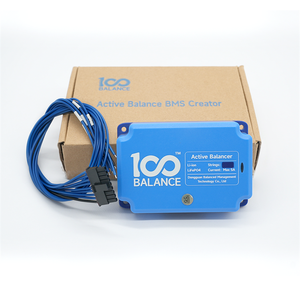
Explore engineered Lithium Iron Phosphate battery modules, capacitive active balancing boards, and smart PCM protection hardware designed for utility, residential, industrial, and high-reliability energy storage installations.
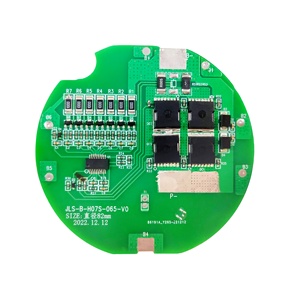
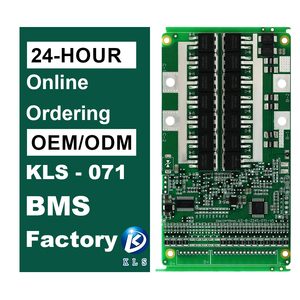
As global energy systems shift rapidly toward decentralized microgrids, commercial & industrial (C&I) solar storage, and high-reliability backup power, selecting a qualified custom LiFePO4 energy storage pack supplier in China has become a vital strategic imperative for OEM engineers, procurement managers, and energy integrators. Lithium Iron Phosphate (LiFePO4 / LFP) has definitively established itself as the dominant electrochemistry for stationary energy storage due to its exceptional thermal runaway threshold ($>500^\circ\text{C}$), superior cycle life ($>6,000$ cycles at 80% Depth of Discharge), zero reliance on volatile nickel-cobalt supply chains, and outstanding levelized cost of storage (LCOS).
However, turning raw prismatics or cylindrical LFP cells into a safe, durable, high-efficiency energy storage system (ESS) requires deep engineering mastery across mechanical design, thermal isolation, high-voltage busbar assembly, and real-time electronic management. This comprehensive technical whitepaper analyzes the engineering dynamics, procurement trends, and technological breakthroughs governing modern custom LiFePO4 battery pack manufacturing.
The operational longevity and usable capacity of multi-cell LiFePO4 battery packs (e.g., 16S 48V, 32S 100V, or 512V high-voltage storage banks) depend fundamentally on individual cell state-of-charge (SOC) equilibrium. Over hundreds of charge-discharge cycles, subtle variations in internal resistance ($\Delta\text{IR}$), self-discharge rates, and ambient thermal gradients induce cell imbalance.
Legacy passive balancing bleeds off excess electrical energy from higher-voltage cells purely as thermal waste through bleeding resistors (typically limited to 50mA–200mA). In high-capacity packs (100Ah–300Ah), passive balancing fails to correct severe cell drift, generates unwanted ambient heat inside sealed IP67 enclosures, and wastes valuable stored solar energy.
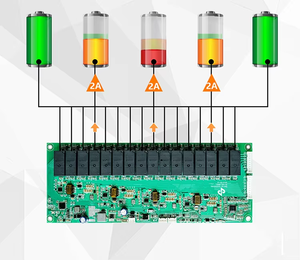
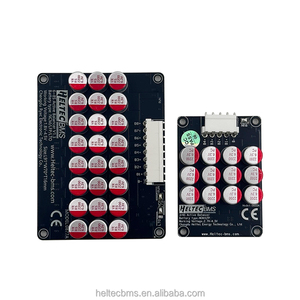
Next-generation active balance equalizers utilize high-frequency capacitive energy transfer or inductive balance circuits (delivering 0.6A to 5.5A continuous balancing current). Instead of burning off power, active balancers dynamically shift charge directly from peak-voltage cells to low-voltage cells with over 92% efficiency, reducing cell voltage deltas to $\Delta V < 5\text{mV}$.
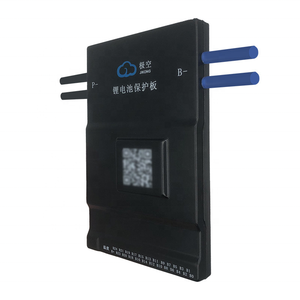
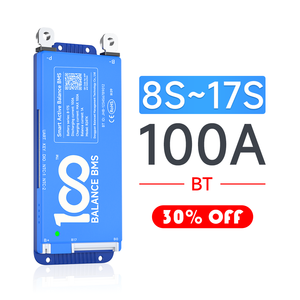
Integrating high-current active balancers—such as the Heltec 5.5A Active Equalizer or JIKONG JK-BD6A24S15P Smart BMS—extends pack cycle life by up to 30%, unlocks previously inaccessible pack capacity, and eliminates thermal stress points inside high-density residential and industrial energy storage enclosures.
Global B2B procurement of custom LiFePO4 battery packs is undergoing rapid structural evolution. To maintain competitive advantage, system integrators must align their supply chain criteria with four macro trends driving the energy storage industry:
While low-voltage (48V / 51.2V) systems remain the standard for residential power walls, commercial and industrial projects are swiftly pivoting toward High-Voltage (200V–800V) DC bus systems. HV configurations drastically lower current draw, reducing copper busbar weight, minimizing system $I^2R$ electrical transmission losses, and improving overall inverter conversion efficiency. OEM suppliers must possess proven engineering expertise in multi-series cell isolation and master-slave distributed BMS topologies.
Modern enterprise energy storage units are no longer passive battery boxes; they are cloud-connected digital assets. Leading China OEMs integrate multi-protocol telemetry (CANbus 2.0B, RS485, Modbus-RTU, Bluetooth, Wi-Fi, and 4G/GPS) directly into the BMS PCBA. Real-time data streams enable cloud-based AI algorithms to forecast State of Health (SOH), detect microscopic internal short circuits, and schedule preventive maintenance long before catastrophic pack failure occurs.
Global market access hinges on comprehensive international compliance. Tiers of regulatory verification—including UL 1973 (stationary batteries), UL 9540 (energy storage systems), UN 38.3 (transport safety), IEC 62619 (industrial safety), and CE-EMC—are now baseline requirements for European and North American deployment. Custom manufacturers must provide fully traceable test reports and certified production lines under ISO/IATF quality management frameworks.
Geopolitical supply chain disruptions have made single-region sourcing risky. World-class battery suppliers have established dual manufacturing footprints—combining advanced R&D centers in China with overseas automated assembly facilities (such as Vietnam production campuses)—giving global clients flexible tariff structures, robust supply continuity, and seamless logistics fulfillment.
Evaluating battery chemistries requires balancing volumetric energy density, electro-chemical stability, cycle longevity, and capital expenditure. The table below outlines key technical parameters across primary industrial battery chemistries:
| Performance Parameter | LiFePO4 (LFP) | NMC (Nickel Manganese Cobalt) | LTO (Lithium Titanate) | Sodium-Ion (Na-Ion) |
|---|---|---|---|---|
| Volumetric Energy Density | 160 – 210 Wh/kg | 230 – 300 Wh/kg | 70 – 110 Wh/kg | 130 – 160 Wh/kg |
| Thermal Runaway Temp. | ~ 500 °C (Ultra-Safe) | ~ 210 °C (Moderate Risk) | > 600 °C (Extreme Safety) | ~ 400 °C (High Safety) |
| Cycle Life (80% DoD) | 4,000 – 8,000 Cycles | 1,500 – 3,000 Cycles | 15,000 – 25,000 Cycles | 3,000 – 5,000 Cycles |
| Active Balance Necessity | Essential (Flat Discharge Curve) | Recommended | Moderate | Essential |
| Cold Temp. Charge Efficiency | Fair (-20°C with pre-heating) | Good (-20°C) | Excellent (-40°C) | Excellent (-30°C) |
| Target Industrial Application | Solar ESS, Telecom, AGV, UPS | EVs, High-Altitude UAVs | Heavy Rail, Ultra-Fast Grid | Budget ESS, Cold Storage |
Building high-performance custom battery packs demands seamless synchronization between electrochemical science, hardware engineering, software development, and quality-controlled assembly. APEX Mobile Power (AMP) delivers end-to-end custom battery manufacturing services tailored precisely to your application requirements:
LiFePO4 cells feature an extremely flat discharge voltage plateau (holding roughly 3.2V across 70% of SOC range). Because tiny voltage variances represent substantial capacity imbalances, conventional passive resistors cannot transfer energy fast enough. Active balancers transfer up to 5.5A of balancing current between mismatched cells, preventing premature low-voltage cutoffs and expanding effective pack capacity by up to 20%.
We offer complete custom engineering across all parameters: pack voltage (12V to 800V+), storage capacity (10Ah to 1000Ah+), physical enclosure form-factor (sheet metal, extruded aluminum, IP67 waterproof molded plastic), active balancing BMS design, communication protocols (CANbus, RS485, Modbus, Bluetooth), LCD status displays, and customized heating films for sub-zero charging.
We source A-grade LiFePO4 cells directly from Tier-1 manufacturers (CATL, EVE, BYD, CALB). Before pack assembly, 100% of cells pass through automated grading stations to measure exact capacity, open-circuit voltage (OCV), and AC internal resistance (AC-IR). Only tightly matched cells ($\Delta\text{IR} < 0.5\text{ m}\Omega$, $\Delta C < 0.5\%$) are grouped into a custom pack.
Our factory operates under audited ISO 9001, ISO 13485, ISO 14001, and ISO 45001 standards. We engineer custom packs to pass UN 38.3 transport testing, UL 1973 (stationary batteries), UL 9540 (energy storage systems), IEC 62619, CE-EMC, and RoHS compliance, providing complete documentation and regulatory support for global market entry.
Preliminary 3D CAD models, schematics, and thermal simulations are completed within 5 to 7 business days. Fully tested prototype packs—complete with custom Smart BMS and CNC-machined enclosures—are ready for evaluation in 3 to 4 weeks, followed by accelerated mass production onboarding.
Need a high-reliability custom LiFePO4 battery pack, active balance BMS solution, or full OEM energy storage architecture? Contact our senior engineering team today to review your technical specifications, request CAD models, or obtain a competitive quotation.
Contact Us