High-precision energy transfer equalizers, high-current smart chargers, and industrial protection PCBA systems for LiFePO4, NMC, and LTO architectures.
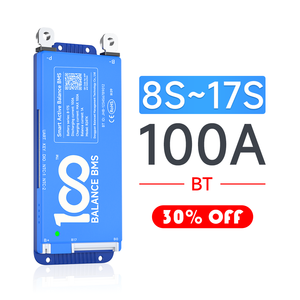
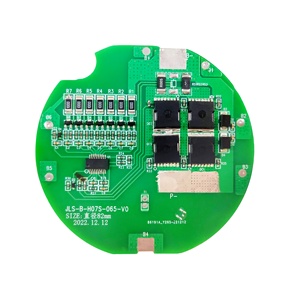

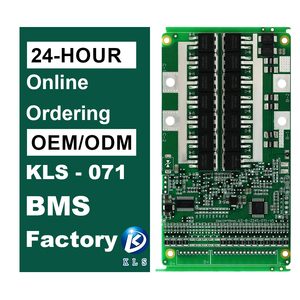
Empowering Tier-1 global brands with military-grade precision, certified quality management systems, and high-yield power electronics assembly lines.
An authoritative industrial guide on thermal dissipation, GaN/SiC power stages, active balance capacitive equalization, and procurement strategies for global exporters.
The rapid shift toward high-capacity energy storage systems (ESS), heavy-duty e-mobility, autonomous mobile robots (AMRs), and critical medical electronics has altered the technical performance expectations for lithium-ion battery chargers. No longer passive power supply units, modern high-current lithium battery chargers are complex energy management nodes. They require precise Constant Current/Constant Voltage (CC/CV) execution, active thermal throttling, multi-protocol bus communications (CANbus 2.0B, RS485, Modbus, Bluetooth IoT), and direct handshakes with Smart Battery Management Systems (BMS).
As tier-1 OEM and ODM manufacturers, specialized factories face the dual challenge of maximizing charging efficiency beyond 96% while safeguarding battery health over thousands of deep cycles. Achieving this requires moving beyond legacy transformer-based or simple analog topologies toward digital soft-switching LLC resonant converters paired with Silicon Carbide (SiC) and Gallium Nitride (GaN) power semiconductors.
High-current charging—defined as continuous charging rates ranging from 30A to over 200A for battery system nominal voltages from 12V to 96V (including 16S 48V LiFePO4 standard configurations)—demands low-loss power transformation. Traditional hard-switching topologies suffer from severe switching losses at elevated switching frequencies, resulting in immense heat generation, bulky magnetics, and shortened MTBF (Mean Time Between Failures).
Integrating GaN FAST FETs and SiC Diodes reduces switching losses by up to 65%. High switching frequencies (200kHz+) dramatically shrink planar transformer cores and inductor footprints.
Achieving Zero Voltage Switching (ZVS) across the entire load spectrum enables maximum efficiency (96.5%+), low EMI noise radiation, and reduced current ripple into battery cells.
Coupling charger firmware with capacitive active energy transfer balancers (5A to 15A balance currents) guarantees that cell-voltage skew is rectified dynamically during the fast-charge phase.
In high-capacity battery packs (e.g., 100Ah to 300Ah LiFePO4 cells arranged in 16S or 24S series), cell impedance and capacity variations become magnified over time. Traditional passive balancing dissipates excess energy from high-voltage cells as heat across bleed resistors—typically limited to low balance currents of 50mA to 200mA. In high-current chargers delivering 50A to 150A, passive balancing is insufficient to keep pace with cell divergence during fast-charging.
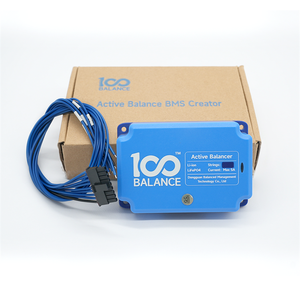
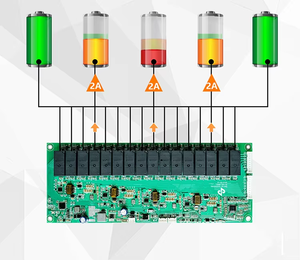
Advanced Capacitive Energy Transfer Active Balancers (such as 5A-15A active balancing systems) solve this bottleneck by taking energy directly from the highest-voltage cells and transferring it non-destructively to the lowest-voltage cells via high-frequency inductor or capacitor switching circuits. This process achieves balancing efficiency exceeding 92%, eliminates thermal buildup inside the battery enclosure, and extends total pack service life by up to 35%.
| Technical Parameter | Standard Charger + Passive BMS | OEM High-Current Smart Charger + Active Balancer | Industrial OEM Custom Advantage |
|---|---|---|---|
| Peak Charging Current | 10A – 20A Continuous | 50A – 150A High-Current Continuous | Scalable Modular Power Stacking |
| Balancing Current Capacity | 30mA – 150mA (Dissipative) | 2.0A – 15.0A (Active Transfer) | 100x Higher Correction Rate |
| System Power Conversion Efficiency | 88% – 91% | 95.5% – 97.2% (GaN/SiC Architecture) | Lower Thermal Footprint & Cooling Cost |
| Communication Protocols | None or Basic Analog PWM | Isolated CANbus 2.0B, RS485, Modbus, BLE | Full Telemetry & Remote OTA Updates |
| Cell Chemistry Compatibility | Fixed (Li-Ion or Lead Acid) | Multi-Chemistry (LiFePO4 / NMC / LTO / Na-Ion) | Programmable Voltage Curves & Cutoffs |
| Safety & Quality Certification | Generic CE / Basic LVD | ISO 13485, ISO 9001, IATF 16949, UL 2580, CE | Medical & Automotive Level Compliance |
Global procurement teams across North America, Europe, and Asia-Pacific are transitioning away from buying standalone off-the-shelf desktop power adapters toward contracting direct OEM/ODM factory partners capable of delivering integrated battery-charger-BMS ecosystems. Key procurement trends shaping the industry include:
The industrial high-current charger landscape is undergoing structural transformation driven by decarbonization mandates, smart factory automation, and tight supply chain integration:
1. Modular Power Stacking: Rather than producing single heavy monoblock chargers, factories are building modular power sub-units (e.g., 3kW / 5kW hot-swappable power bricks) that fit into 19-inch rack enclosures. This allows enterprise operators to scale charging stations from 5kW up to 60kW as fleet power demands expand.
2. Embedded Cloud Telemetry & Fleet Management: Modern OEM chargers integrate IoT modules (4G LTE / Wi-Fi 6) that send operational metrics—such as cumulative kWh transferred, power factor efficiency, thermal curves, and fault logs—to cloud dashboard systems. Exporters can offer Predictive Maintenance as a Service (PMaaS) to end buyers, signaling capacitor or fan replacement prior to field failure.
3. Enhanced IP Rating & Ruggedization for Harsh Environments: Industrial applications—mining vehicles, marine propulsion, agriculture AGVs, and outdoor ESS installations—require fully potted, IP67 or IP68 waterproof chassis. Liquid-cooled cold plate designs are replacing air fans to survive abrasive dust, saltwater spray, and extreme thermal ranges (-30°C to +65°C).
When selecting a tier-1 Chinese or Southeast Asian manufacturing partner for custom lithium battery chargers and BMS active balancers, technical expertise and quality management systems are paramount. Our factory infrastructure delivers complete turnkey execution:
Our manufacturing lines operate under strict medical (ISO 13485) and automotive quality management standards (IATF 16949), ensuring zero-defect production for critical applications.
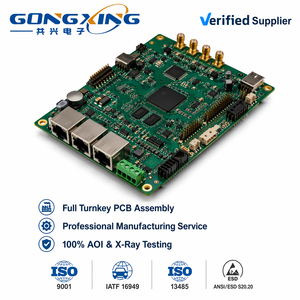
Featuring high-speed Yamaha and Fuji SMT lines, automated optical inspection (AOI), 3D X-ray inspection, and 100% automated burn-in testing under full load conditions.
From custom mechanical enclosures (extruded aluminum, die-cast, IP68 sealed) to custom firmware, customized CAN ID mapping, and private-label branding.
Answers to common engineering, compliance, and custom ordering questions for global B2B buyers and system integrators.
Accelerate your hardware development with custom OEM/ODM power solutions. Contact our engineering team today for technical specifications, custom quotes, and prototype evaluation units.