An AGV Battery Pack is the working core of an automated guided vehicle. It stores electrical energy, controls power delivery, and supports every movement across a factory floor. Unlike a simple battery, it includes cells, a battery management system, connectors, sensors, protection circuits, and a practical enclosure. Together, these parts supply traction motors, steering systems, controllers, and onboard communication equipment.
Dr. Jeff Dahn, a respected lithium-ion battery researcher, has said, “The battery is the heart of the electric vehicle.” His point also applies to AGVs. A reliable AGV Battery Pack must provide steady voltage during acceleration, lifting, turning, and repeated charging. It should also monitor temperature, current, voltage, and state of charge. These details protect the cells and help operators plan maintenance.
The process is straightforward. Cells store chemical energy. The inverter and motor convert that energy into controlled movement. The management system watches for unsafe conditions and balances cell performance. When the vehicle reaches its charging station, the charger restores capacity for the next work cycle.
Small details matter. A loose connector can stop a busy production line. Excessive heat can reduce battery life. Poor charging settings may cause unexpected downtime. Yet no pack is perfect. Real factories have dust, vibration, uneven floors, and rushed maintenance. Therefore, choosing an AGV Battery Pack requires more than comparing capacity. Runtime, charging method, safety design, service access, and operating conditions must be considered together. This article explains how the pack works and where practical decisions can still improve performance.
AGV Battery Pack Definition and Core Components: 24–80 V Systems
An AGV battery pack is the onboard energy system that powers an automated guided vehicle. In industrial applications, 24–80 V systems are common because they balance motor performance, operating time, and electrical safety. A 24 V pack may suit a compact cart, while a 72 V or 80 V pack can support heavier loads and longer routes.
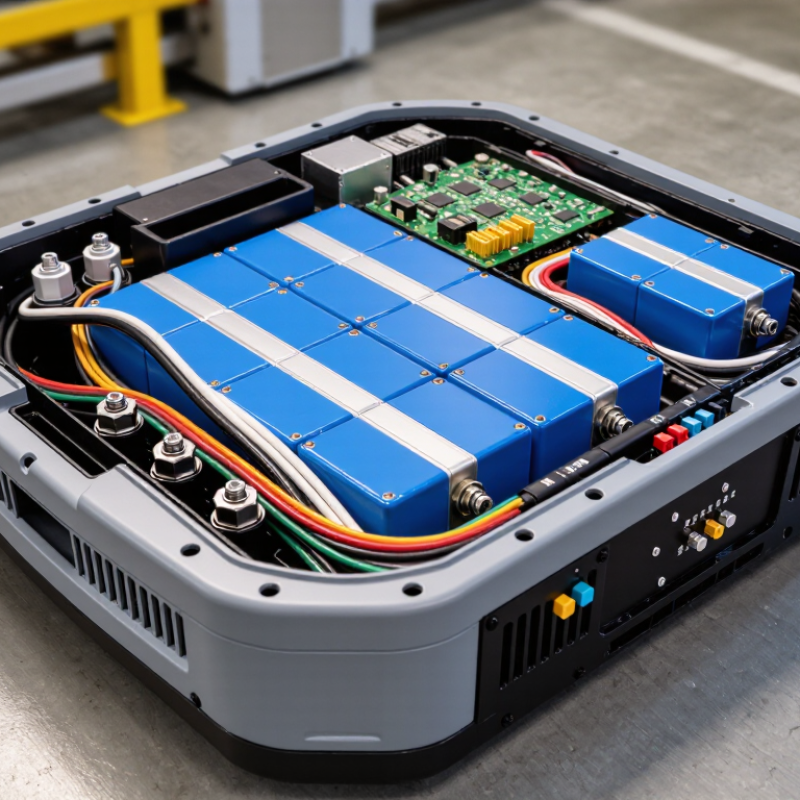
The pack contains several connected battery cells, a battery management system, contactors, fuses, sensors, connectors, and a protective enclosure. The cells store electrical energy. The management system monitors voltage, temperature, current, and state of charge. It can disconnect the circuit when unsafe conditions appear. Sensors are essential. A hot cell or uneven voltage can reduce service life quickly. The enclosure also needs resistance to vibration, dust, and occasional impacts on the factory floor.
During operation, the pack sends direct current to the AGV controller, which regulates power for traction motors, steering, and onboard equipment. A charger restores energy when the vehicle docks or reaches a charging station. Real-world performance depends on payload, route length, acceleration, floor conditions, and charging habits. Rated voltage alone tells only part of the story. A poorly matched pack may cause voltage drops or unnecessary downtime. Engineers should verify peak current, thermal behavior, connector ratings, and available installation space before selection. No design is perfect. Field measurements often reveal assumptions that laboratory tests miss.
What Is an AGV Battery Pack and How Does It Work?
AGV Battery Pack Definition and Core Components: 24–80 V Systems
An AGV battery pack is a rechargeable energy-storage system that supplies controlled DC power to an automated guided vehicle. The chart compares common nominal voltage classes and the theoretical energy available from a 100 Ah lithium iron phosphate battery pack.
A complete AGV battery pack normally includes battery cells, a battery management system, contactors, fuses, current and temperature sensors, busbars, a protective enclosure, charging interfaces, and thermal-management elements. The battery management system monitors voltage, current, temperature, state of charge, and cell balance while protecting the pack from overcharge, over-discharge, overcurrent, and overheating.
How AGV Batteries Store and Deliver Energy at 80–95% Efficiency
What Is an AGV Battery Pack and How Does It Work?
How AGV Batteries Store and Deliver Energy at 80–95% Efficiency
An AGV battery pack combines cells, a battery management system, cooling parts, contactors, and safety sensors. During charging, electrical energy enters the cells and becomes chemical energy. During operation, the cells reverse this process and supply direct current to the drive system. The controller adjusts voltage and current as the vehicle accelerates, lifts, or waits.
Energy efficiency matters in busy warehouses. NREL’s Energy Storage Cost and Performance Assessment reports lithium-ion systems commonly achieving about 85–95% round-trip efficiency. In practice, an AGV may deliver less after charger, cable, inverter, and motor losses. For every 100 kilowatt-hours charged, roughly 80–95 kilowatt-hours may reach useful work. The figure changes with temperature, charging speed, load weight, and battery age. It is helpful, but not perfect.
Tips: Monitor state of charge, cell temperature, and charging history together. Avoid judging battery health from voltage alone. A cool pack usually performs better, yet excessive cooling can waste energy. Regenerative braking can recover energy, although frequent lifting and sudden stops reduce the benefit. The U.S. Department of Energy also identifies thermal management and charge control as important factors in battery performance and service life. Field measurements should confirm published efficiency claims, because real warehouse conditions are rarely ideal.
Lithium-Ion Versus Lead-Acid Packs: 2,000–5,000 Cycle Lifespans
An AGV battery pack stores electrical energy and releases it to motors, sensors, and control systems. A battery management system monitors voltage, temperature, current, and charging status. In a warehouse, the pack must handle repeated acceleration, braking, and long standby periods.
Cycle life separates lithium-ion and lead-acid packs most clearly. Industry testing commonly places lead-acid packs near 2,000 cycles, while lithium-ion designs can reach roughly 5,000 cycles. NREL’s 2023 review on battery degradation notes that depth of discharge, heat, and charging speed strongly affect these results. Those figures are not promises.
Lead-acid chemistry remains practical where purchase cost matters. However, it usually needs ventilation, watering, and scheduled replacement. Charging can also occupy several hours, which may require spare packs and manual changes. That extra handling is easy to underestimate.
Lithium-ion packs accept opportunity charging during short breaks. They usually deliver steadier voltage, less routine maintenance, and higher usable capacity. The European Commission Joint Research Centre’s 2023 industrial battery assessment also links lifetime performance to thermal control and operating conditions. A poorly cooled lithium pack can age faster than expected. Real warehouses are rarely perfect. Dust, cold loading bays, uneven floors, and rushed charging all reduce theoretical cycle counts. Engineers should compare total operating cost, not only the initial pack price.
BMS Safety Functions: Voltage, Temperature, and Current Monitoring
An AGV battery pack is more than a group of lithium-ion cells. It is a controlled power system that moves vehicles, lifts loads, and supports repeated warehouse cycles. The battery management system, or BMS, watches every critical electrical condition. This matters as automation expands. The International Federation of Robotics reported 541,302 industrial robot installations worldwide in 2023. Many mobile systems depend on reliable rechargeable packs.
Voltage monitoring begins at cell level.
The BMS compares individual cell voltages and checks the total pack voltage. If one cell rises too high during charging, the system can reduce charging current or open the contactor. If voltage falls too low, it can limit discharge. Passive balancing may remove small energy differences through resistors. It is simple, but not especially efficient.
Temperature sensors usually sit near cells, busbars, and charging interfaces. Heat can accelerate ageing, while cold conditions can reduce available power. The BMS may stop charging or restrict vehicle movement when temperatures exceed safe limits. Current sensors measure charging and discharging flow. They help detect overloads, short-circuit risks, and abnormal operating patterns. The International Energy Agency reported that global battery demand from the energy sector exceeded 750 GWh in 2023, showing the scale of battery dependence across applications.
No sensor is perfect.
A loose connector, delayed reading, or poorly placed probe can weaken protection. Conservative limits improve safety but may reduce operating time. Engineers should validate thresholds through real duty-cycle testing, not only laboratory assumptions. A BMS should also record alarms, state of charge, and state of health for maintenance decisions. That record can reveal gradual capacity loss before an AGV stops unexpectedly.
Charging AGV Battery Packs: 1–3-Hour Fast Charging and Opportunity Charging
What Is an AGV Battery Pack and How Does It Work?
An AGV battery pack stores electrical energy for automated guided vehicles moving materials through warehouses and factories. It usually combines battery cells, a battery management system, connectors, cooling parts, and protective housing. The management system monitors voltage, temperature, and charging status during operation. This protection is essential because repeated deep discharge can shorten battery life.
Charging AGV battery packs commonly takes one to three hours, depending on capacity, chemistry, charger output, and operating conditions. A suitable charger should match the pack’s voltage and communication requirements. Charging too aggressively may create excess heat, especially when ventilation is poor. Maintenance teams often check charging records, terminal condition, and temperature trends rather than relying only on dashboard alerts. That window matters.
Opportunity charging uses short pauses to add energy during natural breaks, such as loading, unloading, or shift changes. An AGV may charge for ten minutes several times daily instead of waiting for a full recharge. Small pauses help. This method can support continuous workflows, but it requires accurate scheduling and accessible charging stations. If vehicles arrive simultaneously, the available power may become insufficient. Poor timing can also cause queues and uneven battery use.
In practice, operators should set charging limits based on measured duty cycles, not assumptions. A pack that performs well in a cool test area may behave differently near a warm conveyor line. Fast charging is useful, but it is not automatically better. Regular inspections, clear records, and realistic energy planning protect both uptime and battery condition. One overlooked detail can change the result.
Conclusion
An AGV Battery Pack is the energy system that powers automated guided vehicles used in warehouses, factories, and logistics operations. Most packs operate within a 24–80 V range and combine battery cells, electrical connections, protective housing, and control components. They store energy chemically and release it as electrical power to drive motors and onboard systems, typically achieving an energy efficiency of about 80–95%. This performance directly affects vehicle travel time, load capacity, and operating reliability.
Lithium-ion and lead-acid battery packs offer different advantages, with suitable designs commonly providing approximately 2,000–5,000 charge cycles. A built-in battery management system monitors voltage, temperature, and current to help prevent unsafe operating conditions and extend service life. Charging options include fast charging, which can replenish a pack in roughly one to three hours, and opportunity charging during scheduled pauses. Together, efficient energy delivery, intelligent monitoring, and flexible charging help AGVs maintain continuous and dependable workflow performance.




.png)